The AI Revolution in 2026: Why Agentic Workflows Are Reshaping Everything
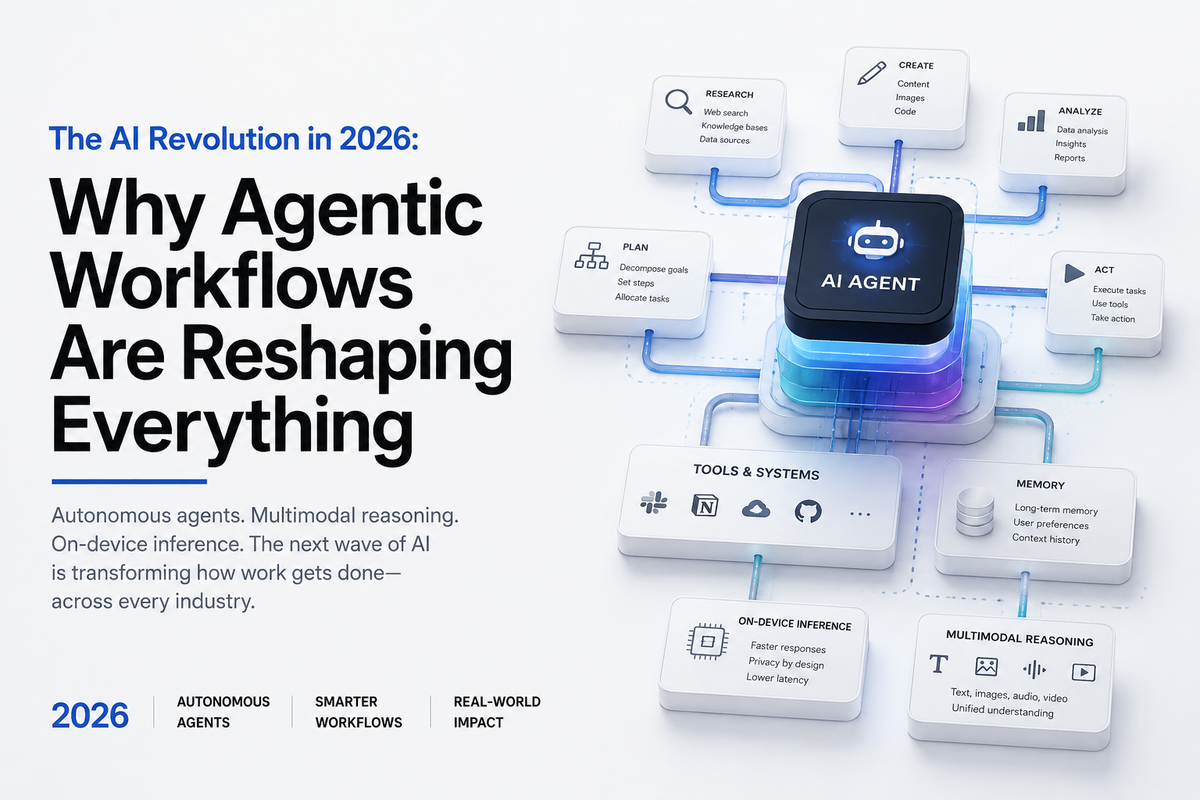
The AI Revolution in 2026: Why Agentic Workflows Are Reshaping Everything
The pace of progress in artificial intelligence has stopped being a story about benchmarks and started being a story about workflows. In 2026, the conversation isn't whether large language models can write code or summarize documents — it's how autonomous AI agents, multimodal reasoning, and on-device inference are quietly rewiring how work actually gets done.
If you blinked through the last twelve months, here's what you missed.
Agentic AI is the new buzzword — and this time it sticks
For most of the post-ChatGPT era, "AI agent" meant a chatbot with a slightly longer leash. That's no longer true. Modern agentic systems chain tool calls, browse the web, execute code, manage long-horizon tasks, and self-correct when they fail. Frameworks like LangGraph, CrewAI, and the new wave of orchestration platforms have made multi-agent systems genuinely production-ready.
The shift matters because it changes the unit of automation. We've moved from "AI writes a paragraph" to "AI handles the entire research, drafting, review, and publishing pipeline." Whether you call it agentic AI, autonomous workflows, or simply agents, the underlying capability is the same: software that doesn't just respond, but does.
Multimodal is no longer a feature — it's the baseline
Frontier models now treat text, image, audio, and video as a single substrate. Need to analyze a chart, transcribe a meeting, generate a thumbnail, and write the accompanying article? That's one model call now, not five different services duct-taped together.
The downstream effect is that vertical AI tools are getting absorbed into general-purpose models. Standalone transcription apps, image taggers, and basic OCR services are getting commoditized fast. The winners are platforms that wrap intelligence around proprietary data, workflows, or distribution.
Open-source is closer to closed-source than ever
Two years ago, the gap between GPT-4 class models and the best open-weight alternatives felt insurmountable. In 2026, that gap is measured in weeks, not generations. Models from Meta, Mistral, DeepSeek, Alibaba, and a growing list of labs are running comfortably on consumer hardware while delivering frontier-adjacent quality.
For builders, this changes the calculus. Self-hosting an open model on a single GPU is no longer a research project — it's a Tuesday afternoon. For privacy-sensitive verticals like healthcare, legal, and finance, this is a quiet revolution.
On-device AI is the sleeper trend of the year
Apple Intelligence, Google's Gemini Nano, and Microsoft's Copilot+ PCs have collectively normalized the idea that meaningful AI inference happens on your phone or laptop, not in a datacenter. Latency drops to zero, privacy improves, and per-query costs collapse.
The implications for app developers are significant. Features that previously required an API budget now run for free on the user's hardware. Expect a wave of "no-cloud" AI apps in the next eighteen months.
The bottleneck is no longer the model
Here's the uncomfortable truth: most AI products in 2026 are not bottlenecked by model capability. They're bottlenecked by integration, distribution, and trust. The frontier of practical AI work is increasingly about plumbing — connecting models to real systems of record, building reliable evaluation pipelines, and earning user trust through interfaces that fail gracefully.
This is good news for builders without research budgets. Hand-crafted product experiences and domain expertise are competitive moats again.
What to watch in the second half of 2026
A few signals worth tracking: the maturation of agent evaluation benchmarks (we still don't have a great way to measure agent quality), the regulatory follow-through on the EU AI Act's high-risk classifications, the next wave of vertical AI startups in healthcare and legal, and the ongoing question of whether reasoning models continue to scale or hit a wall.
The meta-trend underneath all of this: AI is finally becoming infrastructure. It's getting cheaper, more reliable, more embedded — and, crucially, more boring. The breathless demos are giving way to quiet integrations that just work. That's usually the sign a technology is finally crossing into mainstream productivity.
For anyone building, writing, or working in this space, 2026 is the year the toys started becoming tools.